Advertise

 
Showing posts with label Features. Show all posts
10 Jan 2012

Radio Mama

0 comments

EMTYAZ AL-MOGRABI
NISAA FM may be the call letters of the only public radio station dedicated to Palestinian women, but the station's manager is happy to attract male listeners and also employ them. “Social change does not happen unless women and men work together,” believes Maysoun Odeh, whose station employs a staff of five women and three men. “We are a mature society. Both men and women deserve a chance to be free of the oppression we are facing today, so that we earn our deserved roles.”

NISAA began broadcasting in June 2010 and today an estimated 40 per cent of its listeners are men, though the station's most sizzling broadcasts are focused on women. Alaa Shatira, who hosts the radio show ‘Women's Break', devotes a section of her programme to issues that affect Palestinian women and has invited on-air experts on women's issues to help spread awareness of their rights. Another popular programme, ‘Coffee Mazboot', discusses Palestinian women's formal and informal work in Israeli settlements and across the Green Line, which marks the boundaries between Israel, the West Bank and Gaza.

In an occupied land where men exert overwhelming media control, the station offers a unique forum for such subjects as polygamy, domestic violence, family and work matters, says Palestinian journalist and film producer Saad Aruri. “Having a women's radio station in Palestine that touches on issues of concern to women across the Middle East is critical and very positive,” he says. “So I hope it will continue to develop.”

He added that NISAA FM plays an important role by advising women in the Arab world about their rights and providing an example of the Palestinian community that supports gender equality.

According to Odeh, among Palestinian women, the topic of polygamy is particularly popular. “It is beginning to surface here more than any other community,” she says. Palestinian women widely believe that the introduction of a second wife into the family home will destroy her life and that of her children. Many non-governmental organisations have picked up their cause and are calling for an end to polygamy. But the practice is so entrenched in Palestinian culture and tradition that most segments of society, with the exception of educated women, still consider polygamy completely “natural”.

While the station pays particular attention to Palestinian women, it also tries to reach the broader audience of Arab women, addressing topics such as so-called honour killings and domestic violence.

Odeh wants to go further though. She dreams of setting up an investigative unit and broadcasts that reach women and men across the Arab world. “I want NISAA FM to be heard in every city and town in Palestine and in other Arab countries.”

(By arrangement with Women's eNews / WFS)

courtesy: The Hindu
Read more...
28 Dec 2011

Israeli navy attacks international observers, injures Palestinian, on monitoring boat in Gaza waters

0 comments

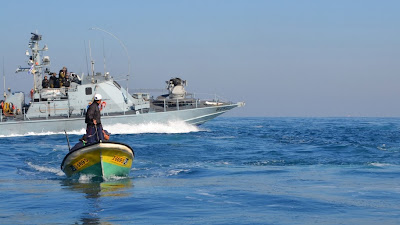
At 10:55 am, an Israeli naval warship attacked the international observers and Palestinian captain of the Civil Peace Service Gaza (CPSGAZA) boat Oliva, injuring its captain in an apparent attempt to capsize it.
Photo: Rosa Schiano, Civil Peace Service Gaza (CPSGAZA)
The two international observers, both Italian citizens, are available for media questions or interviews.
"The Israeli navy passed near us and the fishermen, and started to go around us, creating waves," said Rosa Schiano, one of the international observers. "The fishermen escaped, but we couldn't because of a problem with our engine. We couldn't move, and they went around us very quickly. The Israelis saw that we couldn't move, and that the captain was trying to fix the engine, but they didn't stop. We told them, 'Please stop! Please stop!' But they didn't."
When the warship was two meters away from the Oliva, one of the waves it had created nearly capsized the small boat, filling it with water and causing the Palestinian captain to fall out, injuring his left leg.
"Their intentions were to do something very bad," said international observer Daniela Riva. "Coming so close to us was very dangerous, and they obviously knew that."
After more than twenty minutes, the warship retreated, and the Oliva was rescued by a small Palestinian fishing boat, or hasaka, which threw it a line and towed it toward the shore.
Photos are available for free use with attribution to Rosa Schiano, Civil Peace Service Gaza (CPSGAZA): http://bit.ly/CPSGAZAphotos. 
Background

Restrictions on the fishing zone are of considerable significance to Palestinian livelihood. Initially 20 nautical miles, it is presently often enforced between 1.5 - 2 nautical miles (PCHR: 2010). The marine 'buffer zone' restricts Gazan fishermen from accessing 85% of Gaza's fishing waters agreed to by Oslo.

During the Oslo Accords, specifically under the Gaza-Jericho Agreement of 1994, representatives of Palestine agreed to 20 nautical miles for fishing access. In 2002 the UN Secretary General Kofi Annan empowered Catherine Bertini to negotiate with Israel on key issues regarding the humanitarian crisis in the Occupied Palestinian Territories and a 12 nautical mile fishing limit was agreed upon. In June 2006, following the capture of the Israeli soldier Gilad Shalit near the crossing of Kerem Abu Salem (Kerem Shalom), the navy imposed a complete sea blockade for several months. When the complete blockade was finally lifted, Palestinian fishermen found that a 6 nautical mile limit was being enforced. When Hamas gained political control of the Gaza Strip, the limit was reduced to 3 nautical miles. During the massive assault on the Strip in 2008-2009, a complete blockade was again declared. After Operation Cast Lead, the Israeli army began imposing a 1.5 - 2 nautical miles (PCHR: 2010).

The fishing community is often similarly targeted as the farmers in the 'buffer zone' and the fishing limit is enforced with comparable aggression, with boats shot at or rammed as near as 2nm to the Gazan coast by Israeli gunboats.

The fishermen have been devastated, directly affecting an estimated 65,000 people and reducing the catch by 90%. The coastal areas are now grossly over-fished and 2/3 of fishermen have left the industry since 2000 (PCHR: 2009). Recent statistics of the General Union of Fishing Workers indicate that the direct losses since the second Intifada in September 2000 were estimated at a million dollars and the indirect losses were estimated at 13.25 million dollars during the same period. The 2009 fishing catch amounted to a total of 1,525 metric tones, only 53 percent of the amount during 2008 (2,845 metric tones) and 41 percent of the amount in 1999 (3,650 metric tones), when the fishermen of Gaza could still fish up to ten nautical miles from the coast. Current figures indicate that during 2010 the decline in the fishing catch continues. This has caused an absurd arrangement to become standard practice. The fisherman sail out not to fish, but to buy fish off of Egyptian boats and then sell this fish in Gaza. According to the Fishermen's Union, a monthly average of 105 tons of fish has been entering Gaza through the tunnels since the beginning of 2010 (PCHR 2009).

For More Information
Daniela Riva, 059 913 2853
Rosa Schiano, 059 250 8778

Read more...
27 Dec 2011

Petition: Lift Travel Restrictions on Palestinian Journalist!!

0 comments
SIGN THE PETITION To: Israeli and Palestinian Authorities - 


Palestinian journalist Khalid Amayreh, who lives in the West Bank, has been invited to attend a media conference in Germany. As required, he set about to request all of the necessary travel documents, including a visa that needs to be granted from the German representative office in Ramallah. After routine questioning regarding his political affiliations, it was not only determined that he was not a member of any party, nor formally associated with any organisation, but it was clear that he had never been arrested or detained by Israeli authorities. Mr Amayreh was granted an entry visa to Germany. However, the Israeli military authorities have refused to give him a permit to leave the West Bank. No Palestinian can travel abroad without receiving such a permit beforehand, otherwise he or she would be turned back once arriving at the Israeli-controlled border terminal at the Allenby Bridge.

Mr Amayreh then went to his local District Coordination Office in Dura, where he was informed that his information was forwarded to the Shin Bet (General Security Services) of the Israeli government. Then two days later, the GSS informed the Palestinian office that Amayreh was “barred from leaving the West Bank for security reasons.” No further explanation was given.

His fortune in obtaining the required travel permission did not change as he applied to the Civil Administration Headquarters in Hebron, a metallic pen holding persons seeking the mandatory permission even to go to East Jerusalem for medical treatment, where it is not unusual to find them huddled and waiting their turn for ten or more hours, under the watchful eye of Israeli military watchtowers.

The Palestinian Civil Affairs Coordination Office in the West Bank was also unable to mediate on his behalf, as they too are entirely dependent upon the decisions, without clarification, evidence or justification, made by the Israeli Security division.

There is indeed no justification for the violation of this man’s civil and human rights, and along with him, the rights of all others who are denied freedom of movement with no justification whatsoever. The Occupation authorities, while they have no sovereignty over citizens of the Palestinian Authority, dictate what must be done with those citizens and the world seems to consider the violation of their rights acceptable and normal praxis. These people are not pawns on a chessboard, but are individuals who seek the basic liberties that all democracies are obligated to provide for their people. The Palestinian Authority does not exercise its duty of guaranteeing civil liberties to its own citizens, and treats them as if they shall be subject to the whims of the Occupier.

We ask for the immediate revision of the decision regarding Mr Amayreh, so that he is granted the documents necessary for him to exercise his freedom of movement allowing him to continue to provide for himself and his family in the work that he is employed in, as well as for the Palestinian Authority to assume a position that sets the freedoms of its citizens as a priority that is greater than the perceived “security” risks declared by the agency of the State of Israel.http://www.petitiononline.com/k1h2a3l4/petition.html
Read more...
24 Dec 2011

Palestine. Continued injustice against women within the Palestinian territories

0 comments
 by Nida’ Tuma

Ramallah, West Bank - A Facebook page with nearly 2000 members has recently attracted the attention of the Palestinian public and media. “Puzzled young women” is becoming an important arena in the debate on women’s rights in the Palestinian territories, a debate which previously lacked one essential element: dialogue with proponents of a more traditional role for women.
 The page is run by a group of young Palestinian women who lobby and fight against injustice towards women and initiate dialogue with those who have differing views. Members use the page to ask legitimate questions about the situation of women within different communities. Topics range from early marriage, to violence against women, the right of inheritance and so-called ‘honour’ killings. Many members claim that the institutions working in this sector have so far accomplished very little in addressing these important issues.

The founders of this Facebook group say their primary concern is the continued injustice against women within the Palestinian territories. They insist that the oppression of women is in direct contradiction with the Palestinian objective of ending Israeli occupation and attaining independence. The founders ask: how can we insist on our freedom as a people when we also insist on limiting the freedoms of certain groups in our society, namely women?

In the heated debate following the murder of Aya Baradiya – a young woman from the southern West Bank who was reportedly killed by her uncle because he did not approve of the man she was in a relationship with – a breakthrough in the long struggle for equal rights was achieved as young women rallied to discuss this atrocity on Facebook. The uproar was heightened by local and international media coverage of this horrible crime, resulting in an amendment of a law that had enabled lenient sentencing for men who kill a female relative. The amendment is significant, even if it is ignored in the Hamas-ruled Gaza strip, which severely restricts women’s liberties and rights in Gaza.

Although changes in legislation are important, social traditions within the Palestinian territories too often stand in the way of progress. As such, education and dialogue are becoming much more crucial in challenging traditions and a conservative culture.

The site’s administrators hold discussions, as well as online dialogue with journalists, religious clerics and key politicians, such as Hanan Ashrawi, the only female member of the Palestinian Liberation Organization Executive Committee. The group also welcomed remarks by the Palestinian television anchor Mohammad Abu Obaid, who criticised women for not putting up a strong enough fight for their rights.

Engaging opposing camps in these discussions broadens the horizon of the debate and allows those involved to tackle issues that concern both sides.

Many opponents of women’s rights argue that some of the rights enjoyed by women in Western countries run counter to Islamic law and culture and that this could lead to social decadence. Some discussions revolve around the Westernisation of Arabic culture and the threat to age-old customs and traditions. They also worry that Western values could lead to severe familial challenges including high divorce rates, children born out of wedlock and the phenomenon of single mothers.

The subject of honour takes up a large share of the discussions. Many women argue that society applies a double standard when dealing with women. While it tolerates men having extra-marital relations, women who do so are considered disgraceful.

Although at times, the discourse — still in an early stage of development — lacks the sophistication found in similar discussion elsewhere, it reflects the profound need to begin to talk about these issues.

Those who manage the "Puzzled young women” page often turn to religious men for support. But they are not the only ones. In a religiously conservative society, women’s associations, such as the Palestinian Violence Against Women Forum, rely on Muslim imams to address violence against women and issues like inheritance rights in their Friday sermon. This is noteworthy because although this trend will not necessarily mobilise religious leaders to join the general struggle for women’s liberation, it does demonstrate that there are resources within the religious community that may be utilised to ease women’s plight.

Compared to some other Arab countries, Palestinian women are considered to fare better. The fact that there are women in influential public positions and women leaders in fields like education, management and politics confirms this idea. However, Palestinian women are still struggling for certain rights that women in Western countries take for granted.

Whatever the future holds for the struggle for Palestinian women’s rights, it is clearly a dynamic and transformative process – with the potential to spill over into politics and other areas of society, helping create a modern, strong and just state.

###

* Nida' Tuma is a freelance journalist who lives in Ramallah. She holds a B.A. degree in Media from Birzeit University. This article was written for the Common Ground News Service (CGNews).

Dec. 25, 2011
Read more...

We are Condemned!!

0 comments

The Palestinian magazine, Zayzafouna, published an article in February written by a teenage girl who presented four role models: a medieval Persian mathematician, a modern Egyptian novelist, the Muslim warrior Saladin, and the Nazi leader. This is indeed an irony that a ten year old girl is writing in praising Hitler. Narrating one of her dream she says “I turned to the next door; there Hitler awaited me. I said, 'You're the one who killed the Jews?'
He [Hitler] said: 'Yes. I killed them so you would all know that they are a nation which spreads destruction all over the world. And what I ask of you is to be resilient and patient, concerning the suffering that Palestine is experiencing at their hands.'
I said [to Hitler]: 'Thanks for the advice.'”
This translation was made public by Palestinian Media Watch, an Israeli organization that tracks incitement in Palestinian media.
The magazine's director, Shareef Samhan, did not dispute the translation, though he said the girl was "accusing" Hitler and not praising him. He said he had not been aware of the text and noted that Unesco was not a central backer of the magazine.
He defended the publication. "We depend in the content of our magazine on the participation of school students, and it's not our job to prohibit the freedom of speech," he said. However the magazine’s director’s justification is in-convincing to this strongly deplorable and condemnable reproduction of such inflammatory statement in the magazine.
As expected, UNESCO issued a statement that it "strongly deplores and condemns" the "unacceptable" material and would cease funding the magazine. UNESCO also said it funded three different issues later in 2011, and not the one in question.
The magazine also receives funding from the Palestinian Authority, the Western-backed Palestinian government in the West Bank. A spokesman for the Palestinian Authority, Ghassan Khatib, said the article was "not acceptable."
"We educate young people in our textbooks about the Holocaust and the massacres of Hitler against Jews and against others, and we refer to these massacres as crimes against humanity," Mr Khatib said. "This instance is exceptional, and the editor will try to be more careful in the future."
This is why; it is indeed an irony that a ten year old girl thinks about the most inglorious holocaust from a very militarily oppressed country as an act for the benefit of humanity. So who is responsible? Magzine’s editor solely!! That ten year old child cannot be blamed for anti-Semitism in her article. This is juvenile to think if this girl even understands the meaning of anti-Semitism. An oppression cannot insure the uprising remain progressive always. The history itself shows Hitler rising in a war torn country. Palestinians have been fighting genuinely for their rights for long. In India too, Subhash Chandra Bose collaborated with Hitler to fight against British Colonialism. Bose intentions cannot be criticized but his association with Hitler can be. While thinking against Israel, this is easy to glorify the most inglorious holocaust for a ten year girl but she perceived it from the society and this society is condemned. We are condemned.
Unesco email exchange with The Simon Wiesenthal Center 
Read more...
 
IndiaPalestine.com © 2011 IndiaPalestine.com